This dashboard provides a summary of course items from the Student Rating of Teaching (SRT) survey, which is administered to students to collect information on instructors and the courses they teach.
Student Rating of Teaching data is collected in the Student Rating of Teaching (SRT) system. Surveys are conducted in the last days or weeks of a course.
Report Update Cadence:
After grade entry is nearly complete for Summer (September/October), Fall (January/February), and Spring (June) terms.
- Responses are on a 6-point scale indicating the level of agreement with a given statement, with values (1) strongly disagree, (2) disagree, (3) somewhat disagree, (4) somewhat agree, (5) agree, and (6) strongly agree.
- These dashboards include SRT data from Twin Cities, Rochester, and Morris.
- Courses administered by the College of Continuing and Professional Studies (CCAPS) under Colleges or Departments other than CCAPS are included when filtering to those other Colleges or Departments. For example, see Department = CCAPS Online & Distance Lrning
Academic term
A defined period of instruction that is a subunit of an academic year in a specific academic year. Examples: Fall 2021, Spring 2022
Academic year
The annual period of instruction that includes fall, spring, and summer terms. It is set based on the calendar year in which fall term falls, e.g., the academic year 2015-16 goes from Fall 2015 through Summer 2016.
Campus
The University of Minnesota locations at Crookston, Duluth, Morris, Rochester, Twin Cities and the entities that report to them.
Catalog number
A code which, in conjunction with the subject, identifies the course in the course catalog and identifies the level at which the course is taught. Examples: 4221, 8211, 5221.
College
A unit of the University of Minnesota, offering courses of instruction, usually leading to a degree, that furthers the University’s teaching, research, and outreach mission.
College in the Schools (CIS)
Courses taken by high school students to earn both high school and college credits. These are University of Minnesota courses taught in the high schools.
Course level
The level of the course based on the first digit of the catalog number. Examples: 1xxx, 5xxx
Department
Identifies the organizational level at the University where budgets, staff, or academic programs are managed.
Instruction mode
Class Instruction Mode: Method of instruction delivery. Includes: hybrid, in person, online, and other. ‘Other’ includes study abroad and independent study courses.
Subject
The area of study to which a course is related. Examples: CHEM, MATS, ANTH
Term
Term (Academic): A defined period of instruction that is a subunit of an academic year. Examples: Fall Semester, Spring Semester, Summer Term. Note: Prior to Fall Semester 1999, the University of Minnesota operated on a quarter system (example Winter Quarter).
- Learn how to use Tableau Dashboards and Views.
- Data Visualization Overview Guide (PDF)
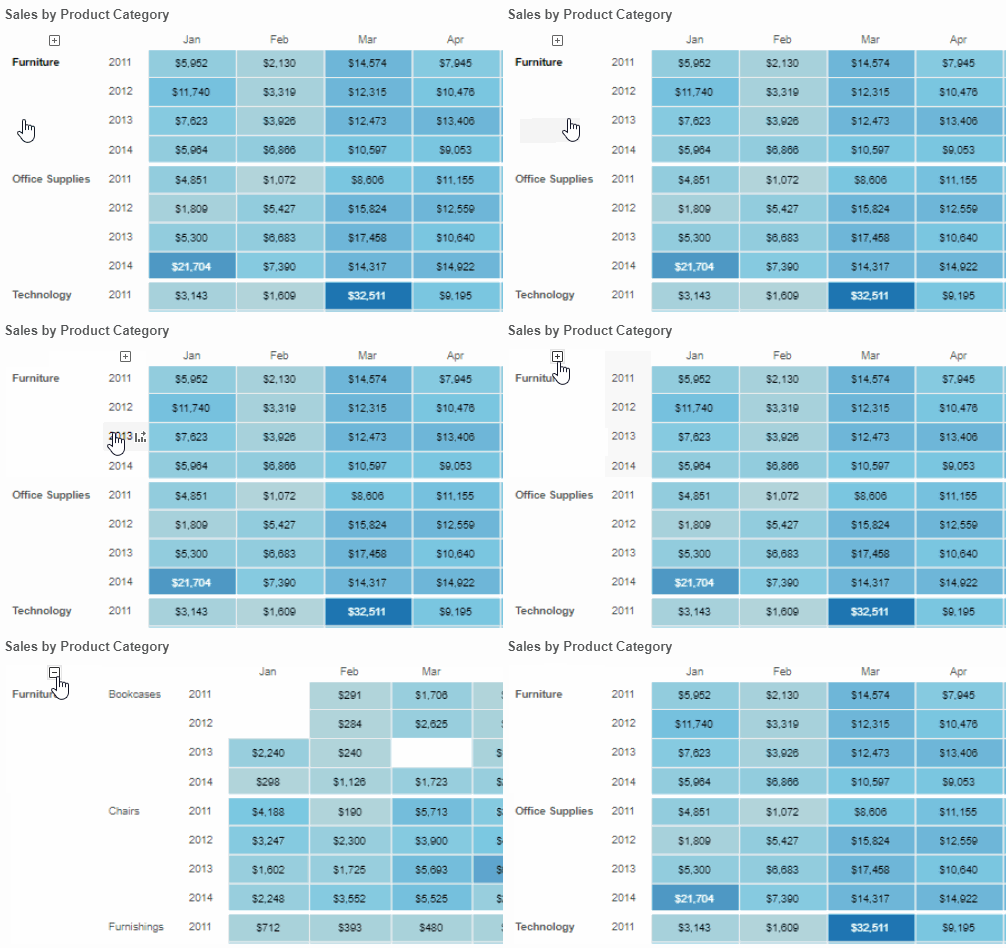
- Tableau hierarchy +/- operator instructions:
Some dashboards use the plus/minus sign in a heading to either expand or collapse content categories. When hovering next to a field label you may notice a + or - operator. By clicking on this operator you can drill into or out of the hierarchies. Explore a visual representation of how to use the +/- hierarchy operators.
This report has been reviewed for the 7 Core Skills of Accessibility and updated to the extent possible. To request the data in an alternate format, or to report a web accessibility-related issue, contact [email protected].