
The University of Minnesota Postcollegiate Outcomes (PCO) project tells a more complete story of our graduates' paths after receiving their degree. By linking multiple non-survey data sources, we capture data on a large share of alumni across the system and at all degree levels. This integrated data paints a systemwide portrait of what our undergraduate, graduate, and professional alumni are doing for further education and employment 5, 10, and 15+ years after graduation.
More data
With another year of earnings and further education results, the oldest cohort (2006) can now be tracked over a 17 year period. The earnings and further education of nearly 240,000 alumni across the University of Minnesota system are now available from 2007 to 2023.
Comparative functionality added
Show results by
- All
- Campus
- College
- Award Level
- Broad subject area
Filtering has been expanded (new filters in italics)
Where applicable, is available and can be applied across sheets by
- Campus
- College
- Award Level
- Graduation Year
- Broad subject area (CIP 2)*
- Specialized subject area (CIP 4)
*replaced ACS field filter
New dashboard added
- UMN Graduate and Professional Earnings vs. MN comparisons across time
This project analyzes the journeys of University of Minnesota graduates by combining internal university records with two external data sources.
Source 1: Minnesota Unemployment Insurance (UI) Wage Data
This data, from the Minnesota Statewide Longitudinal Education Data System (SLEDS), allows us to track employment and earnings for alumni working in Minnesota.
- Coverage: Includes approximately 95% of all jobs in Minnesota.
- What this data excludes: The data does not include everyone working in the state. Key exclusions are:
- Self-employed individuals and independent contractors
- Federal government employees
- Those employed by certain religious non-profits
Source 2: National Student Clearinghouse (NSC)
The NSC provides information on further college degree attainment for our alumni after they graduate from the U of M.
- Coverage: Captures degree data from nearly all U.S. postsecondary institutions.
Project Scope & Methodology
We track cohorts of graduates over time to understand how they establish themselves in their careers and educational paths.
- Alumni Tracked: Nearly 240,000 alumni who earned degrees or certificates between 2006 and 2022.
- Degrees Included: The project follows graduates who earned bachelor's, master's, doctoral research, and professional degrees and certificates. The dashboards show results of UMN alumni by the following award levels:
- Bachelor's degree
- Master’s degree
- Doctor’s degree-research/scholarship
- Doctor’s degree-professional practice
- Pre-bachelor’s certificate
- Post-bachelor’s certificate
- Post-master’s certificate
Earnings
- Earnings for UMN graduates are calculated using quarterly earnings records from Minnesota’s Unemployment Insurance database and aggregated on a calendar-year basis. These earnings are inflation-adjusted to 2024 dollars utilizing the U.S. Bureau of Labor Statistics Annual Average Consumer Price Index for All Urban Consumers (CPI-U). Earnings are reported by year after graduation to facilitate meaningful comparisons across cohorts entering the workforce in different years.
- The earnings of UMN graduates are not adjusted for additional education. For example, earnings reported for a baccalaureate degree, include those who earn additional credentials, if applicable.
Industry
- The industries of employment for UMN graduates are tracked quarterly using Minnesota Unemployment Insurance (UI) records. Industries are classified by the 3 digit North American Industry Classification System (NAICS) codes. NAICS is the standard used by federal statistical agencies in classifying business establishments. Its primary purpose is to collect, analyze, and publish statistical data related to the U.S., Canadian, and Mexican business economies.
Further Education
- Further educational attainment of UMN graduates is tracked through National Student Clearinghouse records, capturing up to four additional credentials. This accounts for the discrepancy between the number of graduates and the higher number of degrees/certificates reported.
Data Governance
- The Postcollegiate Outcomes Project follows the Minnesota Unemployment Insurance Program’s data governance policies and is aligned with the University’s Enterprise Data Management & Reporting policies.
- To ensure confidentiality, cells with fewer than 10 graduates are suppressed in the employment outcomes dashboards, preventing results from being displayed for such groups.
American Community Survey (ACS) Earnings
Bachelor’s comparison: The ACS median earnings used in the benchmarking dashboard are estimates based on the American Community Survey Subject Table B15014, Median Earnings in the Past 12 Months (in 2023 Inflation-Adjusted Dollars) by Age by Field of Bachelor’s Degree for First Major, ACS 1-Year Estimates Detailed Tables, 2023, U.S. Census Bureau, U.S. Department of Commerce. The ACS reports median earnings for the overall Minnesota population aged 25 to 64, as well as for a subset aged 25 to 39, with earnings and a Bachelor's degree or higher. Currently, only three years of data are available (2022, 2023, & 2024).
Graduate/Professional comparison: The ACS median earnings used in the benchmarking dashboard are estimates based on 14 years of data (2010 - 2023) from the American Community Survey Subject Tables S2001, Earnings in the Past 12 Months, ACS 1-Year Estimates Subject Tables, U.S. Census Bureau, U.S. Department of Commerce. The ACS reports median earnings for the overall Minnesota population 25 years and over with earnings by educational attainment: less than high school graduate, high school graduate, some college or associate’s degree, bachelor’s degree, and graduate or professional degree.
In both of these Tableau reports, the ACS salary estimates are reported in 2024 inflation-adjusted dollars to allow for a more direct comparison with the UMN PCO data.
Classification of Instructional Programs (CIP) Code
A federal numeric (6-, 4-, and 2-digit) code assigned to a specific academic program. The classification system is nested, that is the 2-digit CIP codes are the broadest subject areas, the 4-digit CIP code is more specialized, and the 6-digit is the most detailed (program level).
Degree Conferred Year
Degree Conferred Year is based on the actual calendar year (January-December) in which a degree was awarded. This differs from the traditional academic year and serves to align UMN cohorts with MN UI wage records.
Employment Calendar Year
Employment Calendar Year is the 12-month period from January through December that MN UI employment data corresponds to.
Field of Degree (ACS)
To benchmark UMN graduates against national data, we use 6-digit CIP codes to map UMN's majors to the detailed ACS Field of Degree description categories. These detailed categories are then grouped into broader ACS Fields of Degree for higher-level analysis and reporting. The 15 Fields of Degree used by the U.S. Census Bureau's American Community Survey (ACS) also corresponds to 2-digit CIP codes (see table below). The ACS Fields of Degree are based on self-reported majors from Minnesota ACS respondents.
Biological, Agricultural, and Environmental Sciences
- Examples (by CIP Code): 01 (Agriculture), 03 (Natural Resources), 26 (Biological Sciences)
Business
- Examples (by CIP Code): 52 (Business, Management, Marketing)
Communications
- Examples (by CIP Code): 09 (Communication & Journalism), 10 (Communications Technologies)
Computers, Mathematics, and Statistics
- Examples (by CIP Code): 11 (Computer Science), 27 (Mathematics & Statistics)
Education
- Examples (by CIP Code): 13 (Education)
Engineering
- Examples (by CIP Code): 14 (Engineering)
Liberal Arts and History
- Examples (by CIP Code): 24 (Liberal Arts), 38 (Philosophy), 39 (Philosophy), 54 (History)
Literature and Languages
- Examples (by CIP Code): 16 (Foreign Languages), 23 (English)
Multidisciplinary Studies
- Examples (by CIP Code): 30 (Multidisciplinary Studies)
Other. This is a general category for fields not classified elsewhere.
- Examples (by CIP Code): 12 (Personal Services), 19 (Family & Consumer Sciences), 31 (Parks & Recreation), 43 (Security & Protective Services), 44 (Public Admin & Social Service), 46 (Construction Trades)
Physical and Related Sciences
- Examples (by CIP Code): 40 (Physical Sciences)
Psychology
- Examples (by CIP Code): 42 (Psychology)
Science and Engineering Related Fields
- Examples (by CIP Code): 4 (Architecture), 15 (Engineering Technologies), 49 (Transportation), 51 (Health Professions)
Social Sciences
- Examples (by CIP Code): 05 (Area & Ethnic Studies), 45 (Social Sciences)
Visual and Performing Arts
- Examples (by CIP Code): 50 (Visual & Performing Arts)
Location of Employment
Location of employment is based on the five digit zip code of employment location as of 2023.
Further Education Institution
Further Education Institution is the institution of higher education where UMN graduates earned further credentials, included alongside the name is the state location of the institution.
- Related policy and research briefs and professional presentations based on postcollegiate outcomes of UMN graduates.
- Learn how to use Tableau Dashboards and Views.
- Data Visualization Overview Guide (PDF)
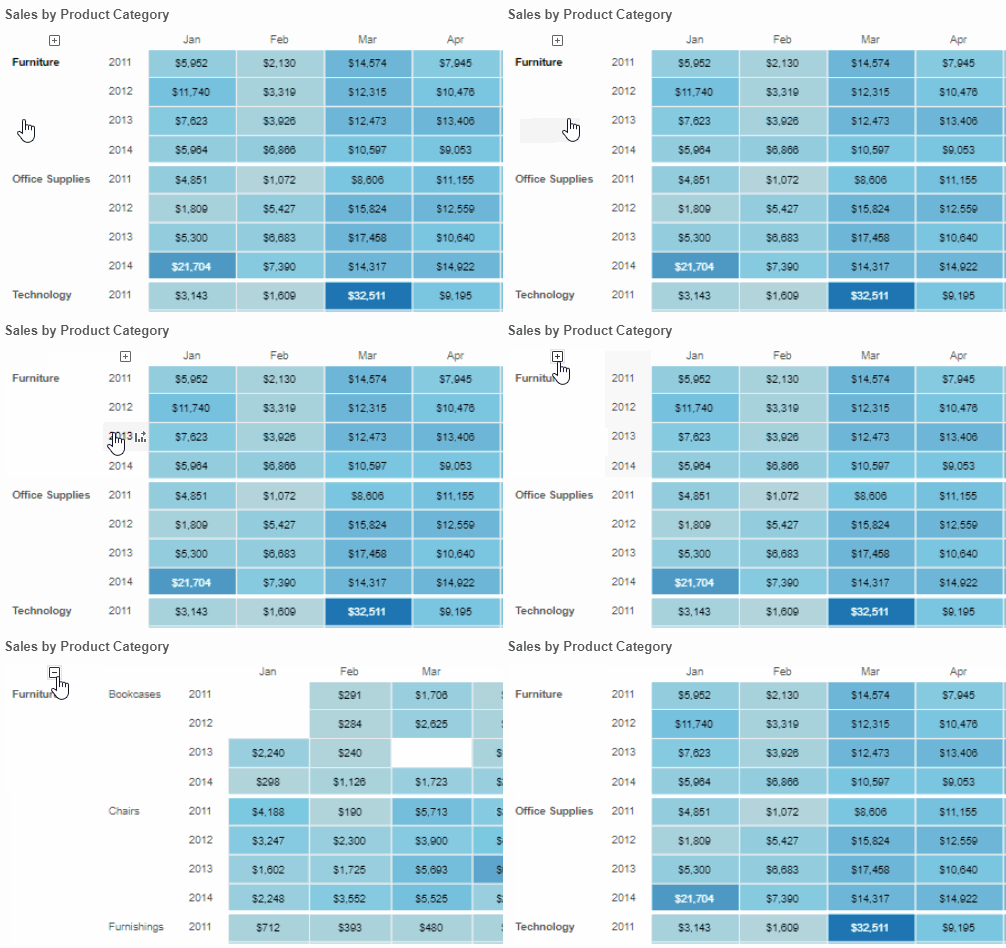
- Tableau hierarchy +/- operator instructions:
Some dashboards use the plus/minus sign in a heading to either expand or collapse content categories. When hovering next to a field label you may notice a + or - operator. By clicking on this operator you can drill into or out of the hierarchies. Explore a visual representation of how to use the +/- hierarchy operators.
This report has been reviewed for the 7 Core Skills of Accessibility and updated to the extent possible. To request the data in an alternate format, or to report a web accessibility-related issue, contact [email protected].